


This year, on July 4th, America turned 250 years old.
This makes our nation relatively young, but interestingly enough we have the oldest national constitution still in use in the world.
Something about it has stood the test of time.
Yet, 11 days after our nation’s birthday, the Democratic Socialists of America (DSA) announced their new national platform. It calls for abolishing the Senate, replacing the President and the Supreme Court with an executive and judiciary chosen by Congress, and completely dissolving our Constitution to draft a new one.
In other words, they want to deconstruct our government and build a new one in their image.
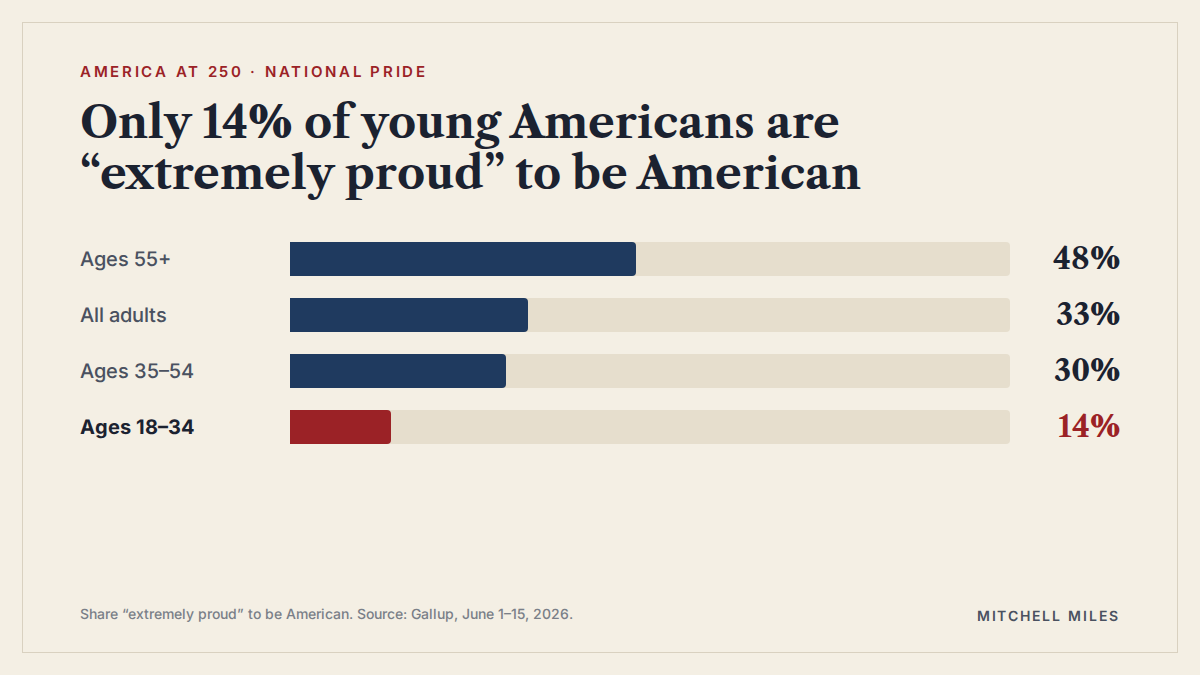
A few weeks prior to this, Gallup released its poll on national pride and revealed that only 33% of Americans are “proud” to be American. That’s the lowest it’s been since Gallup began 25 years ago.
To make it worse, among Americans under 35?
14%.
Now, before you think this is a left-wing problem, it’s not.
Nick Fuentes, a podcaster who has one of the largest young audiences in the country, said that from 1600 to 1960 America was “almost all white, all Christian” and that on a multiracial, religiously pluralistic society, “we kind of need to rethink that.”.
And just this week, a right wing pastor, Joel Webbon, released a video arguing that Republicans need to embrace socialism to win. He went on to argue similar points to Fuentes.
So the far left and the far right are arguing different, but eerily similar, messages. The left wants a new constitution. Part of the right wants a new people.
“We need a new approach.”
Whether it’s a new party, a new constitution, or a new economic policy.
Why does it feel like America is coming apart? And is the solution a “new” anything?
America is coming apart. But the solution is nothing new, and I’ll prove it to you.
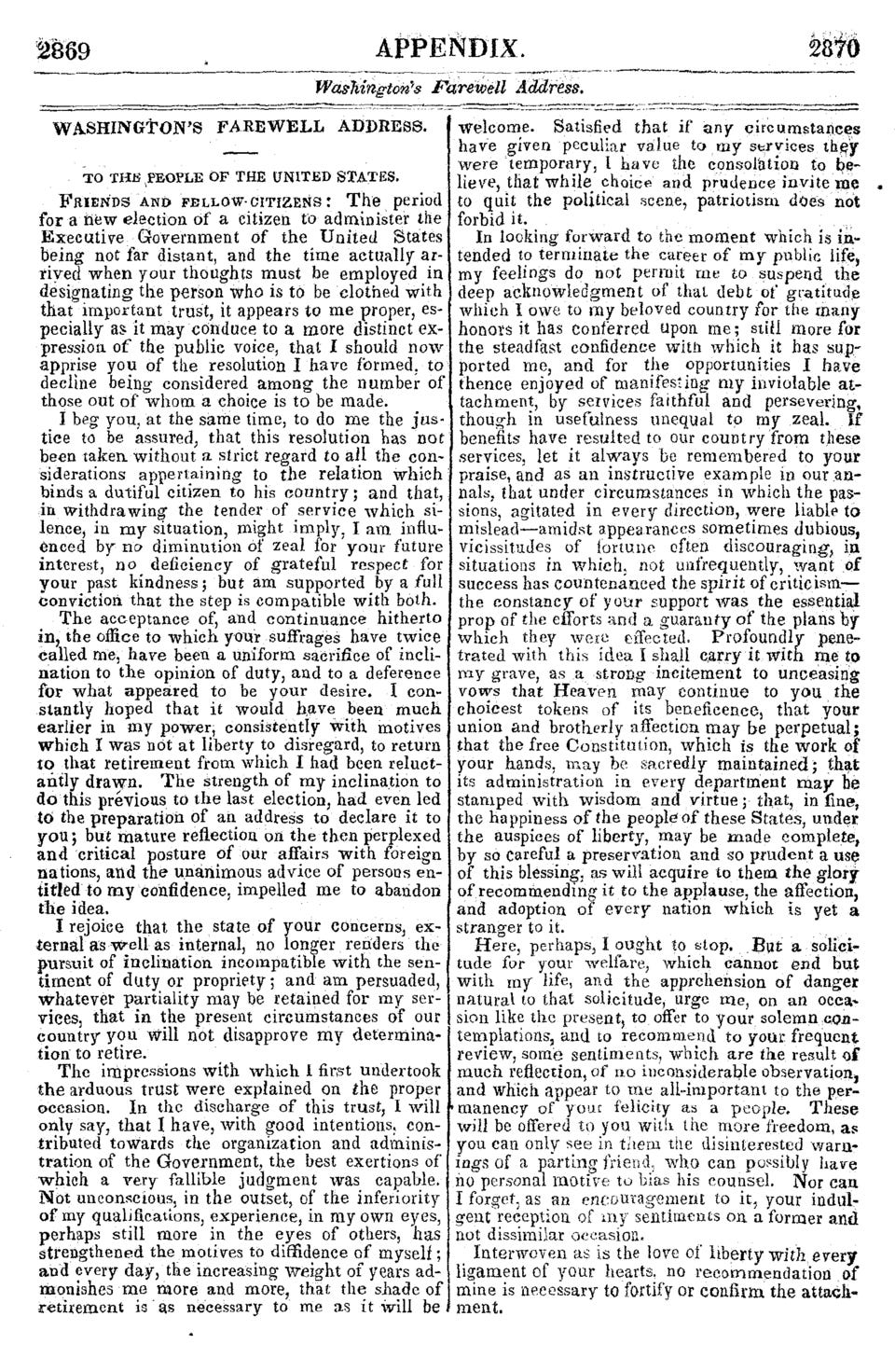
In fact, George Washington warned us about this exact moment 230 years ago. In his Farewell Address, he told Americans to “resist with care the spirit of innovation upon its principles, however specious the pretexts.”
Then he described how the attack would come:
“One method of assault may be to effect, in the forms of the Constitution, alterations which will impair the energy of the system, and thus to undermine what cannot be directly overthrown.”
In other words, beware of anyone selling “something new” for our Constitution. He knew some would try to hollow it out, undermine it, or abolish it completely.
So what did Washington say would protect us?
First, a limited government, such as ours, only works if the people within it govern themselves.
But to govern ourselves, we need an order higher than the state.
What could that be?
Faith.
For the last fifty years of American life, we’ve been testing this theory, and I believe the results prove it true.
In that same Farewell Address, written in September 1796 as he stepped down, Washington named the things he believed the republic could not live without.
“Of all the dispositions and habits which lead to political prosperity, religion and morality are indispensable supports.”
Washington, the man who presided over the Constitutional Convention and led our federal government with no established church, argues that religion and morality are necessary for political prosperity.
He continues.
“In vain would that man claim the tribute of patriotism who should labor to subvert these great pillars of human happiness, these firmest props of the duties of men and citizens.”
So religion and patriotism.
He’s saying you cannot honestly claim to love the country while you are rejecting the pillars that make a free country possible.
“Let us with caution indulge the supposition that morality can be maintained without religion… reason and experience both forbid us to expect that national morality can prevail in exclusion of religious principle.”
He was making it abundantly clear how important this was, because he knew full well how our Constitution structured our government. The limits on our government made our nation free and therefore depended on a moral structure that came directly from our Protestant Christian faith.
Two years later, John Adams said this to the Massachusetts militia:
“We have no government armed with power capable of contending with human passions unbridled by morality and religion. Avarice, ambition, revenge, or gallantry, would break the strongest cords of our Constitution as a whale goes through a net. Our Constitution was made only for a moral and religious people. It is wholly inadequate to the government of any other.”
A Constitution is a net. It can catch a lot, but it can’t catch a whale.
So this is the problem with our government right now.
Our Constitution was created for a moral people but that morality must come from somewhere.
At our founding, it came overwhelmingly from the Protestant Christian faith. 250 years later, we are less Christian than we’ve ever been.
Christianity in practice produces fruit of charity, stewardship, honesty, and virtue.
So what happens when you remove that? The gap doesn’t stay empty. Something must take its place.
Nature abhors a vacuum.
History proves this to be true. If a society has no true religion, it will replace it with a political one.
A political religion that replaces God with the state, pastors with bureaucrats, repentance with re-education, and charity with welfare.
Let’s look at France, for example.
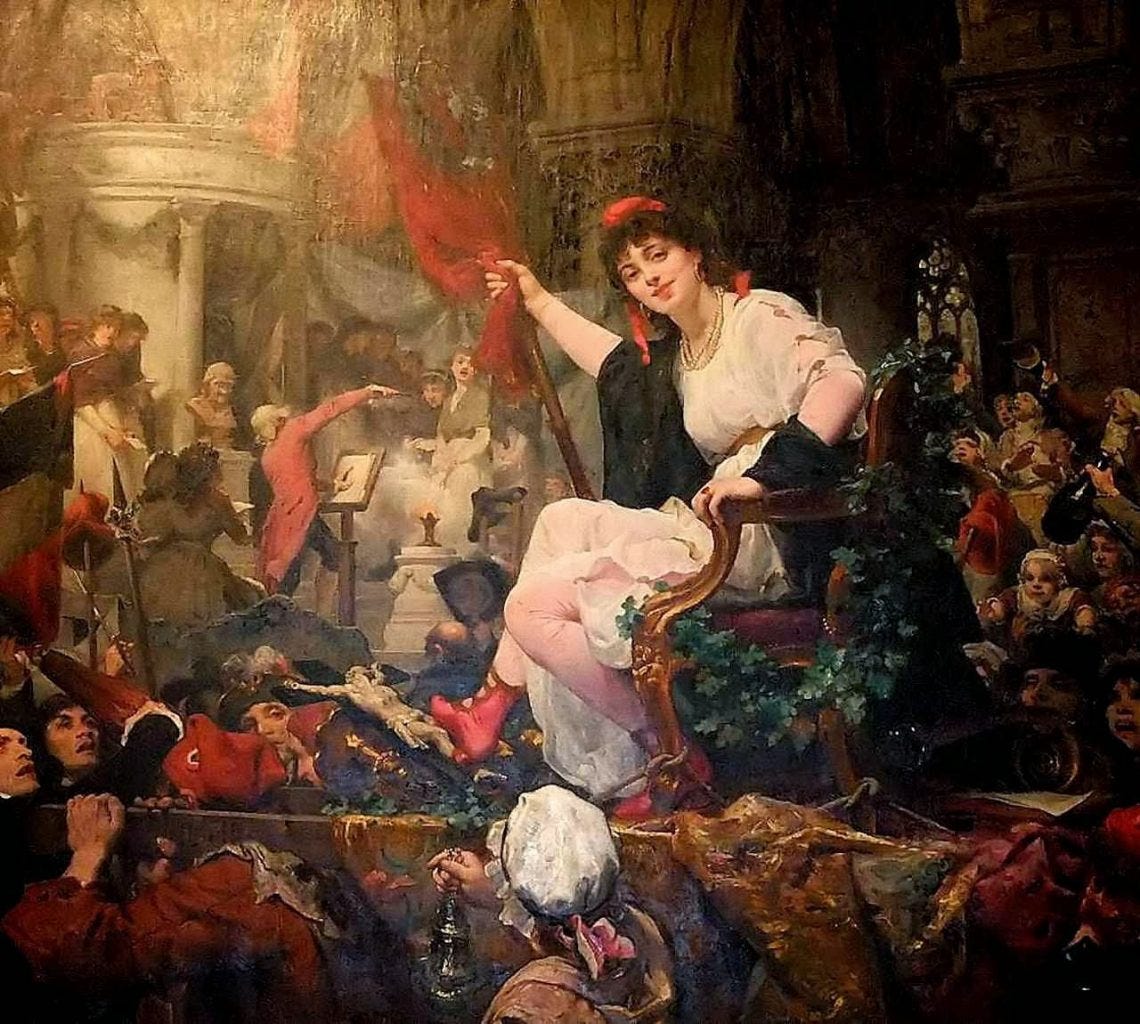
In 1793, the revolutionaries shut down the churches. But they didn’t stop there, they turned Notre-Dame into a Temple and appealed to their god as the “Goddess of Reason.”.
Or what about Russia.
The Soviets literally made atheism official state policy. But then embalmed Lenin and put him on display in a tomb, where people lined up for hours to see his dead body.
They replaced the Bible with Karl Marx. They had their own heresies and even their own confessions. Except these weren’t offered in a church. They were extracted by force at show trials.

In both cases, when they removed God, they replaced Him with the state.
The vacuum will inevitably be filled.
Sometimes atheism or “new thought” and sometimes a counterfeit Christianity.
A Christianity that gets turned into a tribe, bloodline, or a party platform. It’ll quote scripture, monument the cross for all to see, but it’ll miss the main thing.
I’ll no longer be about Jesus. It’ll be about us versus them.
This is how a podcaster like Fuentes can say America was “all Christian” in one breath, and in the next say we need to “rethink” the very values that made America free in the first place.
This is how a pastor like Webbon can demand the government to do the job Jesus gave the church to do.
Both of them talk about faith. But look at where they’re putting their hope.
Not in God. In power.
When faith becomes a tool to win, it stops being faith. It’s just another political religion.
And I’m not saying that every socialist, or every young man watching Fuentes, is intentionally trying to replace God. They very well may sense, correctly, that something is missing.
But I am saying this is the collective pattern. The DSA platform and Nick Fuentes’s comments are not separate phenomena. Two sides of the same coin.
You might think, “What about Scandinavia? “They’re secular yet peaceful.”
Yes, but they have enormous states, some of the highest taxes on earth, and yet again, government filling the roles churches and families used to fill.
This happens every single time.
Even secular figures noticed this firsthand and wrote about it too.
Alexis de Tocqueville, a young French magistrate came here in 1831 to observe and to write about our new and very revolutionary society. He was shocked, as many people were, that a free and equal society hadn’t eaten itself alive.
He watched and observed everything about our laws, our culture, our habits, and so on. His biggest observation was our churches.
He wrote that religion in America “takes no direct part in the government of society,” but that it was “the foremost of the political institutions of that country.”
He noticed that a free people who can legally do almost anything must be the kind of people who will not.
“Thus whilst the law permits the Americans to do what they please, religion prevents them from conceiving, and forbids them to commit, what is rash or unjust.”
This is the underlying relationship between government and freedom.
As government expands, freedom retracts.
For freedom to remain, a people must govern themselves and self-governance is only possible with a strong moral and religious foundation.
The law can be wide only when the conscience is not.
Tocqueville summed it well when he said…
“Despotism may govern without faith, but liberty cannot.”
How, he asked, can society escape destruction “if the moral tie be not strengthened in proportion as the political tie is relaxed?”
This is the trade off.
Every time you loosen the state’s grip, you are counting on the people to grip themselves. That is the deal Washington and Tocqueville both saw, and it is the deal we are breaking.
If the people won’t, the state eventually comes back.
It always comes back, in the name of help and support.
And guess what?
Just as Washington coupled religious morality with patriotism, Tocqueville noticed the exact same thing.
“The Americans combine the notions of Christianity and of liberty so intimately in their minds, that it is impossible to make them conceive the one without the other.”
Religious zeal in this country, he said, was perpetually stimulated by the duties of patriotism. Love of God and love of the country were not in competition at all. In fact, they fed each other.
When I say patriotism, I do not mean blind loyalty. I’m also not saying that America is faultless.
And I definitely don’t mean “blood and soil”.
America was never a bloodline. It’s a creed. A set of beliefs, values, and commitments.
“We hold these truths to be self-evident, that all men are created equal, that they are endowed by their Creator with certain unalienable Rights, that among these are Life, Liberty and the pursuit of Happiness.”
Abraham Lincoln said it best when he talked about immigrants who had no family ties to the Revolution at all. They could still look at the Declaration, he said, and feel “as though they were blood of the blood, and flesh of the flesh” of the men who wrote it.
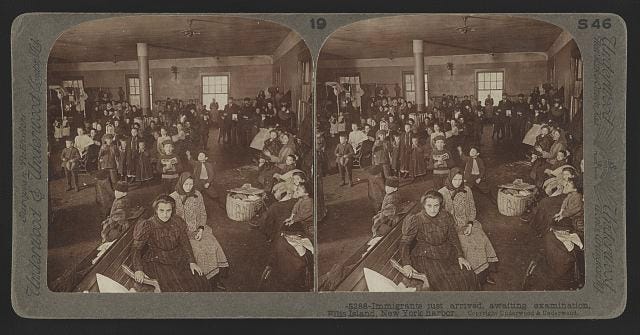
How could that be possible? Because they believed the same truths and committed to it in the same way.
So when someone says we need to “rethink” that, they’re not trying to recover anything or fix anything.
They’re replacing it.
So what do I mean by patriotism?
I mean deep gratitude, veneration even, for an inheritance that others fought to secure.
I mean the simple, unfashionable belief that America is a beautiful place, with a beautiful story, despite its imperfections.
That it’s worth loving, preserving, and handing to your children in better condition than you received it.
You only repair what you still love.
To do that, as Washington and Tocqueville made clear, we need morality that comes from Christian faith, and we need love for our country.
But that’s not quite enough.
We need one other pillar.
In 1765, while the British Parliament was trying to tax nearly all printed paper that the colonies used. This is known as Stamp Act.
And John Adams, 29 years old at the time, wrote this…
“Liberty cannot be preserved without a general knowledge among the people, who have a right, from the frame of their nature, to knowledge, as their great Creator, who does nothing in vain, has given them understandings, and a desire to know.”
In other words, knowledge is a right given to us by God AND it’s a weapon against tyranny.
But he got more specific.
“...an indisputable, unalienable, indefeasible, divine right to that most dreaded and envied kind of knowledge, I mean, of the characters and conduct of their rulers.”
In simple terms, the right to know who is ruling you and what they are doing.
Also known as civics. A general understanding of what’s going on in your local and federal governments is the greatest way to spot propaganda.
This is the most natural defense against authoritarianism.
When Adams wrote this, he saw what Britain was doing from a mile away. Britain was coming to control paper, which is the equivalent of our internet now.
And he was right.
Tyranny does not usually arrive saying “I am tyranny.” It arrives saying, “Trust us, we’re protecting you.”
In other words, “you are too stupid to be trusted with this, so let us handle it.”
And then they always attempt to seize control of information and the narrative.
57 years later, after the Revolution had been won and the Constitution written, James Madison, the main architect of our Constitution, came to the same conclusion:
“A popular Government, without popular information, or the means of acquiring it, is but a Prologue to a Farce or a Tragedy; or, perhaps both. Knowledge will forever govern ignorance: And a people who mean to be their own Governours, must arm themselves with the power which knowledge gives.”
A people who mean to govern themselves must arm themselves with knowledge.
Because a limited government only stays limited if the people know where the limits are. If you don’t know what the government is allowed to do, you’ll never notice when it does more.
So how armed are we?
Last month, the Annenberg Public Policy Center released its 2026 civics survey:
35% of Americans can’t name all three branches of government.
24% can’t name a single right protected by the First Amendment.
Only 43% can name freedom of religion.
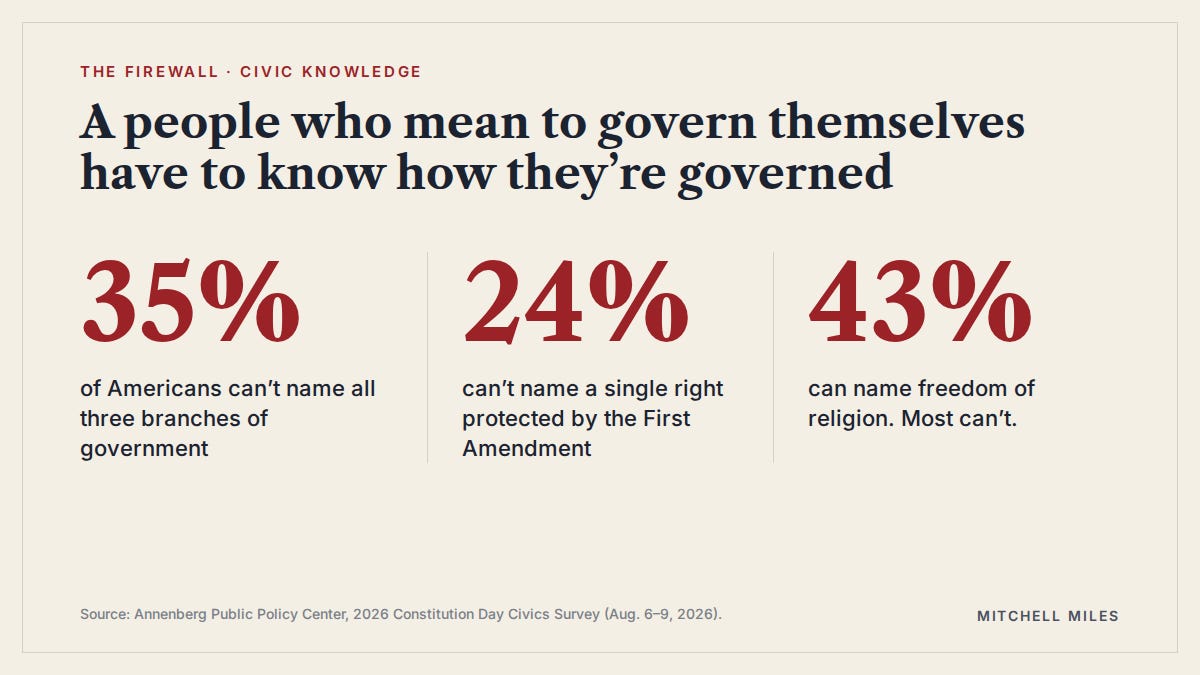
Think about that. So when an organization proposes abolishing the Senate and putting the Supreme Court under Congress, how many Americans could explain what would be lost?
Knowing why the founders split power in the first place is the only thing that makes a proposal like that sound as radical as it is.
These three pillars sustain our Constitution and therefore our limited government.
Love for God.
Love for country.
Diligent knowledge of our history and civics.
A free society with a limited government needs all three at once.
A living and active Christian faith that displays love, mercy, and goodness towards our neighbors.
A love of the country strong enough to fight for it, correct it, and leave it better for our posterity.
A knowledge and understanding of history and civics so we’re equipped against propaganda, lies, and threats.
The crises we keep treating as separate…
The collapse of the family, the growth of the administrative state, the shame campaign against the American story, the inability of young people to say who they are without a political adjective in front of it, and now open calls from both flanks to replace the founding itself…
These are not separate. They are the predictable outcome from a nation that has lost its foundation.
I have spent years writing and speaking about what I call identity dysphoria.
Identity dysphoria, simply put, is the state of distress stemming from the belief that the person you believe you are is not being realized in your life.
What follows is deep shame, then the hunt for relief.
I dealt with this and the only solution came from the truth of the Bible. The Bible doesn’t say to fix yourself by working harder. The story of the Bible makes it clear that we as individuals can only be made new through receiving a new identity in Christ.
It can’t be earned. It is received by faith.
Here’s my point…
A nation also runs on a story it believes about itself. And a nation can lose its mind the same way a person can.
And the solution, what America REALLY needs, is not a new constitution, a new people, a new political party, or a new politician to come and save it.
It needs to receive again what it was given.
Who we are under God.
What this country was for.
What a free people have to know in order to stay free.
Ronald Reagan said it well in 1961:
“Freedom is never more than one generation away from extinction. We didn’t pass it on to our children in the bloodstream. It must be fought for, protected, and handed on for them to do the same, or one day we will spend our sunset years telling our children and our children’s children what it was once like in the United States where men were free.”
He said versions of that for decades, because it is a timeless truth.
Liberty is not inherited like eye color or a trust fund.
The answer is right in front of us and may not be easy, but it is simple.
In our families, churches, and communities, we need to recover the commitment to these three pillars.
Lead by example first. Instead of watching Netflix or scrolling, read Washington’s Farewell Address out loud with someone close to you and discuss it. Stop and ask what they think he meant and share it means to you.
It takes less than an hour.
Then do the same with the Declaration, the Constitution, and the Bill of Rights.
Engage in dialogue with those around you.
Join a Bible-believing church in your area. Attend a Bible Study and ask questions.
Whether you’re a pastor, teacher, parent, or friend, cultivate a love for God, for our country, and diligence for knowledge of history and our government.
This is how a people come back from identity dysphoria at the scale of a nation.
Not by inventing a new America.
By receiving the real one, telling the truth about her, and refusing to let the next generation lose her.
A people who know their true story cannot be enslaved by a false one.
As Jesus said, the truth will set you free.
-Mitchell
Amazing read 🔥great work as always 👏